Introduction
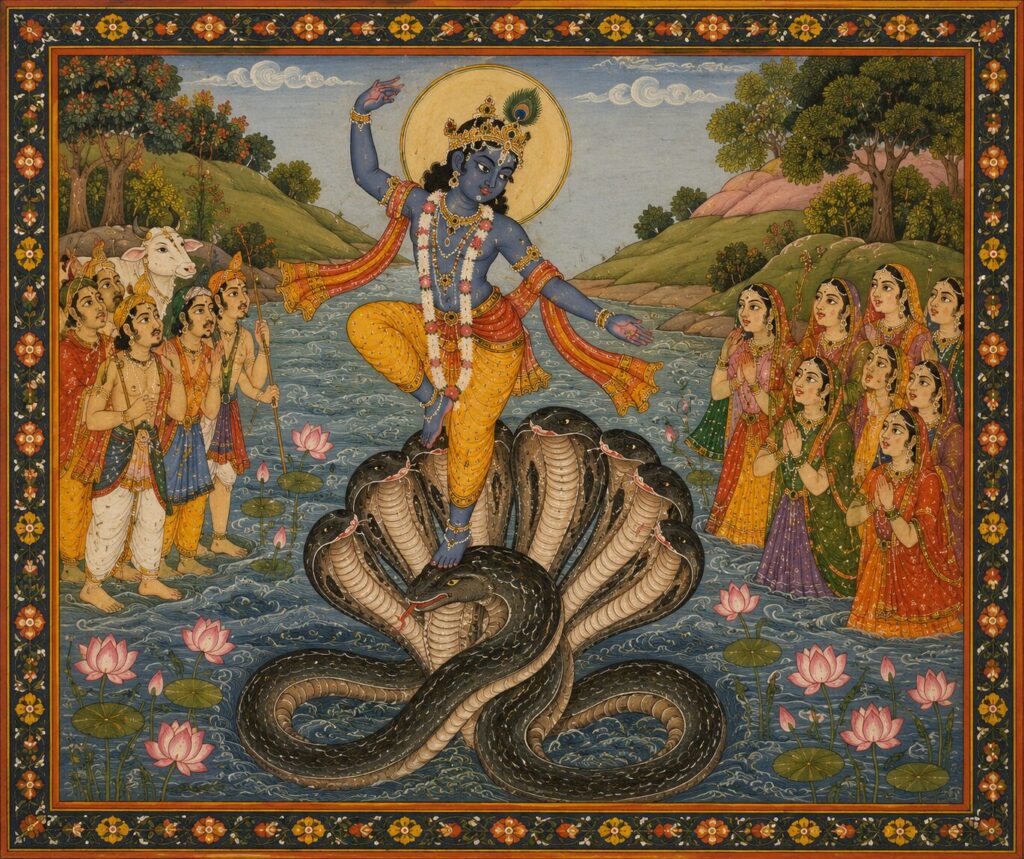
Of the many Vaishnavaite figures we see on the temple walls, the Kaliya Krishna or the Nartana Krishna representing Krishna as the divine dancer. It is not only Shiva, who danced the tandava, but the other gods danced too, and the popular one after Shiva is the Nartana Krishna, wherein Krishna is seen dancing on the hoods of Kaliya, the serpent. The story Krishna and Kaliya is present in the tenth canto of the Bhaagavata Puran. Kaliya, a huge serpent comes to stay in the river Yamuna, thus poisoning the waters with his venom and disturbing life in Vrindavan. Krishna comes to aid, jumps into the water and fights the venomous snake, and subdues Kaliya. To remove the arrogance and the poison out of the serpent‘s head, Krishna then dances on the hood of Kaliya, representing that arrogance and ego do not have place in the goodness of life, and the five elements of life, (Prithvi, Jala, Vayu, Agni and Akash ) are to be preserved and protected but not destroyed. When Kaliya’s wives plead refuge, Krishna forgives Kaliya and grants a boon that Garuda will do no harm to Kaliya as Krishna’s footprints are now embedded on his hood through the lords’ cosmic dance. Less as an idol of worship, but more of a decorative element on the temple walls, it has its own significance of representing Kaliya as the embodiment of everything wicked and evil , and the dance of Krishna on his hood as the victory of the Divine.
Iconography of Nartana Krishna
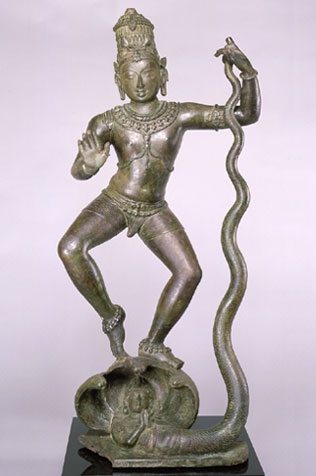
The Shilpa Sastra mentions of Nartana Krishna to be with the right foot on the hood of Kaliya, slightly bent, and the left foot raised up till the shank, ( sometimes the thigh), similar to the Edaka Kriditha ( playful jumping with feet turned out) movement. Although as Venugopala, he is shown with four hands, here, Krishna has two hands, where he holds the tail of Kaliya with one and the other is in the Abhaya mudra. As every sculptural school had its own interpretation and perspective, slight changes in iconography can be seen, yet the variations seen through the sculptor’s eye are acquisitive and one can, but not fail to notice different body, foot and hand positions mentioned in the Natya Sastra in many creative ways.
Nartana Krishna in Sculptures
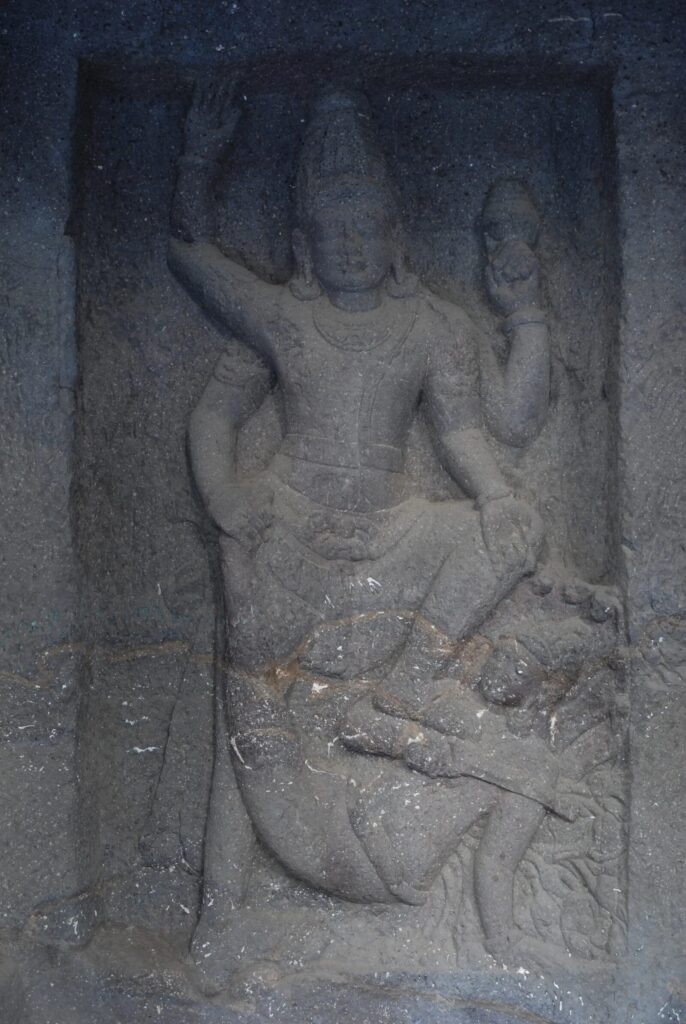
One of the early images of Kaliya Krishna can be traced back to the Rashtrakuta Era, where a sculpture of Nartana Krishna can be seen in the Kailasanatha Temple, Ellora. Although the temple carvings are dominated by Shaivite themes, this specific image located in the corridor of Cave 16 draws the interest of onlookers very keenly, majorily because of two reasons, one is it being a life size figure, and the other is a wonder as to how could such a dynamic figure be carved in the smallest space of the corridor, with attention to detail.
Pic Courtesy : Ellora Caves Documentation Project
For its dynamic energy it portrayed, this theme quickly became the prominent one to be displayed in iconography and sculpture in the Dravidian school of Architecture. During the Chola period, although Shaivism was on the forefront, the theme of Nartana Krishna found its way into the temple through metal, copper and bronze images. However, more than as a rock sculpture on the temple walls, it was given a status of a ritualistic image and used in the temple rituals and processional festivities. The South Arcot region in Tamil Nadu mentions of copper figures of Nartana Krishna in the Kattu-Edayaru temple. A bronze image from the Chola period can be seen in the interior shrine of the Sundara Perumal Koil, Kumbhakonam. Another metal figure form the late 10th period , can be seen in the Royal Asiatic Society Musuem in London.
Courtesy : Asia Society Museum
During the Interregnum period too, Nartana Krishna was a popular theme. The Chalukyas, known for their vivid portrayal of divinities through Silpa and Natya, gave a prominent place to this dancer on the snake. One of an early reference of this sculpture can be seen in the Upper Ahobilam built by Vikrama Setu of Western Chalukyan dynasty in the 12th century. in the Gajavikridhita karana ( the majestic gait of the elephant).
The Hoysala temples are known to follow the Chalukyan ones as their predecessors, while carving a niche of their own. While giving much importance to the dynamism of the Nartanam, they went a step ahead in carving each and every detail in exclusive and intricate beauty. Not only the central image of Krishna on Kaliya, but the other aspects of the surroundings too, are seen given detail. The Halibedu temple boasts of a Kaliya Krishna panel, where Krishna dances in the Urdhwajanu karana on the hood of Kaliya. Kaliya’s wives too are projected in this panel pleading Krishna to let go of their husband. The iconography images of the river Yamuna, the aquatic animals too are seen as part of the panel.
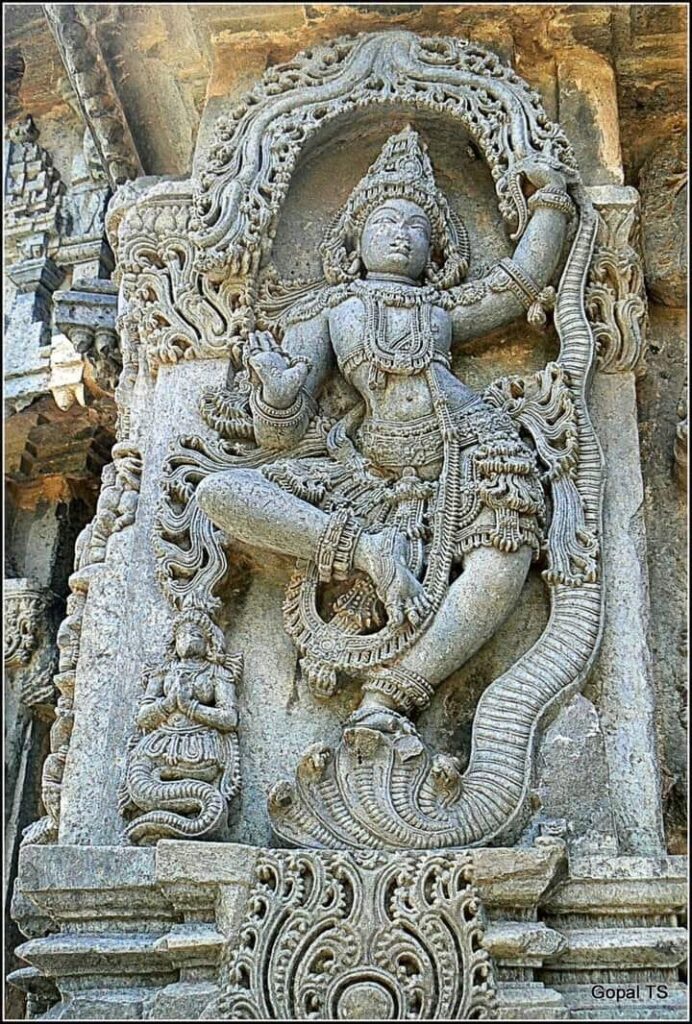
Courtesy : Thiru Srinivasachar Gopal
One can understand a significant point here. It was during the Chalukyan times, that singular images slowly started been accompanied with other divinities especially in medium sized panels. If it was a Shiva image, the Ganas and Parvathi were seen in the panel, if it was Vishnu, he was flanked by goddess Lakshmi and other vaishnavite symbols. Importance was given to the central figure through the entire story carved on a panel. This was seen as a continuing tradition in the Hoysala sculpture, where even miniature panels too had number of figures together.
Nartana Krishna was the most favorite in the Vijayanagara temples. It was the most popular one, only second to the sculptures of Narasimha found in abundance in Vijayanagar temples finding its place in in almost each and every temple built by the Vijayanagara kings. Irrespective of who was the presiding deity, Nartana/Kaliya Krishna image found its place in variegated forms on the temple walls, mantapas, pradakshina pathways roof panels and inner shrines. One of the main reason which can be attributed was the deep rooted belief in Vaishnavism and its wide spread thoughts in the vast kingdom.
One of an early image which stands as the most beautiful sculptural specimen is the image is from the Gorontla Madhavaraya temple, a temple built by Saluva Narasimha Raya in the Anantapur district, Andhra Pradesh. In the image, Krishna holds the tail and body of Kaliya while he dances on the hood. The stance is very much similar to the Edaka Kriditha Caari (edaka – Goat, Kriditha-play Caari – leg movement- the jumping of a little goat) which depicts the playfulness of Krishna while he subdued Kaliya’s pride. Apart from Nartana krushna, one can see There are many more variations to Nartana Krishna, wherein sometimes Krishna is seen holding a ball of butter in his hand, with more striking resemblance to the iconography of Navaneeta Nritya Krishna in Shilpa Shastra, and sometimes Krishna hands are gleefully in air as he enjoys his dance.
The Ahobilam temple has interesting sculptures of Nartana Krishna, mostly similar to the oems at Gorontal temple, but more plain and simple. A sculpture similar to the Chalukyan theme, at Ahobilam can be found in the Ranga mantapa of the Venkataramana temple, Tadipatri and also in the Natya Mantapa of the Lepakshi temple. The later capital of the Vijayanagara rulers, Chnadragiri too has quite a number of Kaliya krishna images carved on the entrances of the fort. Another miniature, but remarkable carving is seen on the main entrance side of the Naagalapuram temple in Andhra Pradesh. What makes it distinct is that the body of Kaliya is woven into a intricate design around Krishna, featuring lata designs, while Krishna stands in Sama pada on the hood, with the dola and the suchi hasta, portraying a sublime message through the suchi hasta that evil is always subdued and warns the ones who pose a threat to Nature. Carving such a deep interpretation into a miniature panel brings out the balance of giving importance to the story while creating a new look all together. Trend setters, the artisans were for sure.
It is difficult to fit in the numerous sculptures of Kaliya Krishna in their utmost creative ways sculpted in the capital city of Hampi. He can be seen in the carvings of the temple streets, broad walkways, entrances to the temples, kalyana mantapas, inner sanctums, and even on the small pillars of a roadside mantapa built for the travelers to rest. However, few sculptures are of necessary mention. One of them stands on a pillar in the old Ranga temple Anegondi, which needs special mention. Krishna is seen standing in the kunchita position with the right leg pressing the hood of Kaliya, while the other is rested on the ground, and with the right hand , he holds the tail of Kaliya. This can be seen as him resting after his energetic dance and calming down, which gives it a unique bearing.
The Hazare Rama temple outer wall has an interesting one. Here, Krishna is seen dancing on the body of Kaiya in the Urudhwajanu karana. What makes him different is his attire, and his little stout body when compared to other sculptures of the same theme. He is richly dressed and his hair flows out like small curly tassels, and importantly the peacock feather is missing,. He looks little flabby, and watching that particular carving, gives idea to a thought, carved to resemble the appearance and the body-built features of the people in those days. One can notice many royals and kings having similar shapes of the body, and hence their divinity too was sculpted similarly. To the one who looks for amusement in art, he is seen as the one who is chubby because of all the butter he has as his staple food!!
Quite the important one in the metropolis of Hampi is the Krishna temple, which has innumerable sculptures of Kaliya and Navaneeta Krishna carved on its pillars, walls, miniature figures and door jambs. While few are in Kuncita foot position, few are with the leg raised. Few are in the dola esctacy, while few are in the abhaya mudra, but every sculpture is a spectacle and speaks volumes of dance gone into each carving. Although they are different, one similarity is that in all sculptures, Krishna dances on the body of Kaliya, not on the hood.
Conclusion
This gives rise to one notion. A sculpture is not just a decorative motif adorning the temple walls, but interprets many of the facets of life a human passes through, Nartana Krishna is a element of art which reminds us how to gain control over our mind.
Kaliya is a snake and a snake’s skin is slippery. The right foot of Krishna holds Kaliya s body firmly in place, not to slip past him and with one hand holds the tail, so that Kaliya cannot attack him by lashing out his tail on Krishna. With the other hand, he controls the hood of Kaliya. And then while raising the left leg, he dances. This is a representation of human mind slipping away to desire and greed, just as the skin of the snake and that is where divine intervention is needed. Krishna is like the control of thought over mind. through which he doesn’t let desire overcome our body , attack us through other means and back doors like Kaliya’s tail, which is why he firmly pacifies our mind reminding us not to give away to the negative. When this balanced control is gained, the human thoughts flow with grace just as his dance, and understand the divine within. Kaliya Krishna is a representation of a lesson that although thoughts have a free will, they should not yonder beyond a point. Nartana Krishna draws the thin line between what is desired, and what is actually needed. Nartana Krishna is a sublime teaching through arts of dance and sculpture that Wicked or Vile, Krishna defeats them all.

The Writer is an internationally acclaimed Kuchipudi dancer, who has performed at more than 100 dance festivals in and outside India. She has done extensive research in the topic of the dance related sculptures and the connection between dance and sculptures. She has also done workshops on various topics of Indian Dance, Art and Culture at multiple universities in USA. Hima is also a part of admin team of Indian.Temples.