
- Introduction
- Inscriptions, Seals, and Epigraphic Evidence
- Importance of Nalanda in travelogues
- Establishment and Decline
- Nalanda’s Architecture and Town Planning
- Sculpture and Artistic Traditions
- Educational and cultural contribute of Nalanda university
- Process of Conservation and Excavation
- Summary
- Bibliography
Introduction
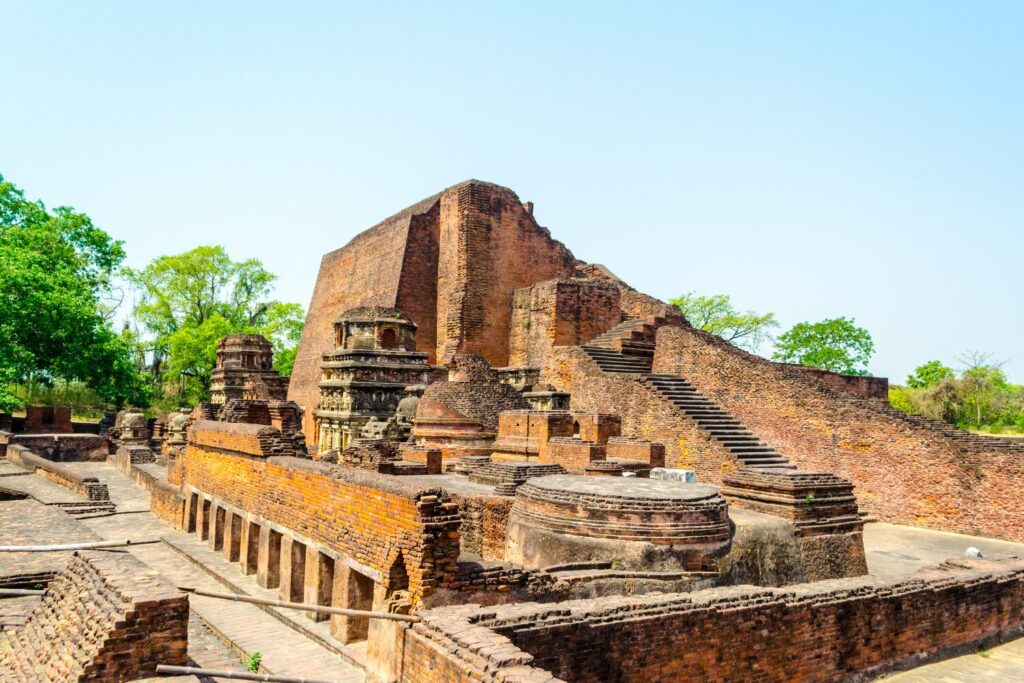
In India’s cultural heritage, Nalanda holds an immensely significant place. Located in the Nalanda district of Bihar, this ancient university was not only the pride of the Indian subcontinent but also became a focal center of knowledge, education and Buddhist culture throughout Asia. Nalanda’s fame was so widespread that students came hear to study from China, Korea, Japan, Mongolia, Sri Lanka, and many Southeast Asian countries. Historical Nalanda is recognized as a great Monastery (Mahavihara), which remained active from around the 5th century CE to the 12th century CE. It is called “the world’s first residential university,” where thousands of students and teachers lived together. The subjects of study were not confined to Buddhist philosophy alone but also included grammar, logic, medicine, mathematics, astronomy, art, and architecture.
From an archeological perspective, Nalanda is extremely important because the remains discovered hear provide us with deep insights into ancient Indian architecture, sculpture, religious life, and the educational system. Excavated Monasteries, stupas, sculptures, inscriptions, and seals reveal the multifaceted character of Nalanda. It’s legacy is preserved not only in it’s physical remains but also in the memory of it’s educational traditions and cultural exchanges. Nalanda stands as a symbol of India’s glorious educational heritage and as a treasure of knowledge and tolerance for all of humanity. For the reason, in 2016, Nalanda Mahavihara was included in UNESCO’s world heritage list.
Inscriptions, Seals, and Epigraphic Evidence
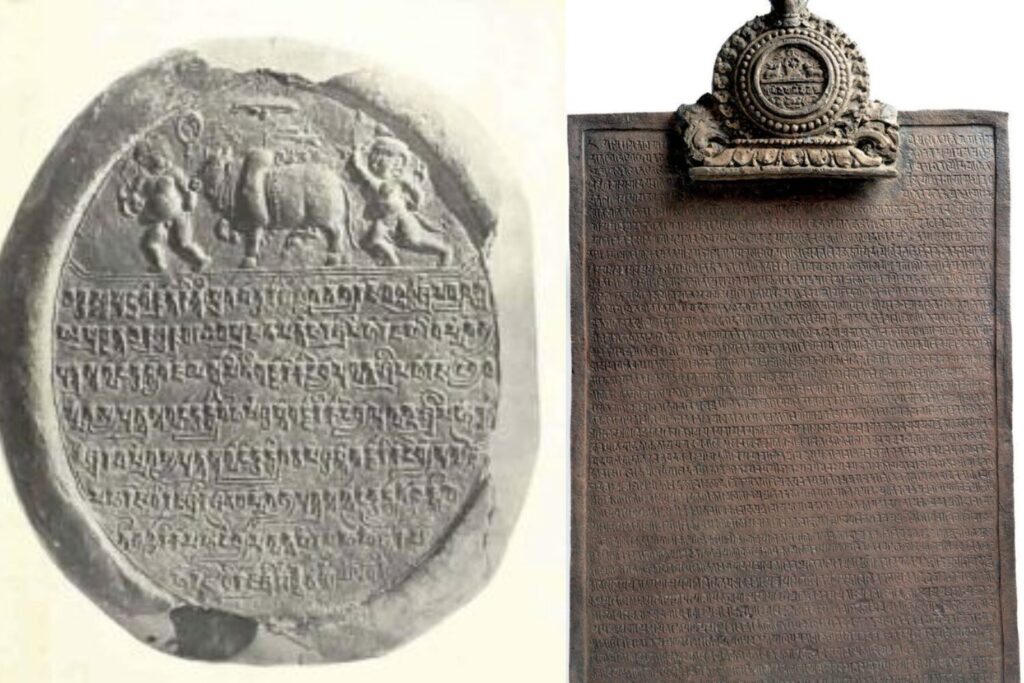
Archaeological heritage is not limited to viharas, stupas, and statues, rather the inscriptions, coins, and Epigraphic evidences found here provide deep insights into it’s historical, religious, and Educational nature. These pieces of evidence clearly indicate that Nalanda Mahavihara was not merely an educational institution but also a well organized entity from administrative economic, and religious perspectives.
Numerous inscriptions have been found at Nalanda, primarily written in Brahmi and Siddhamatrika scripts in Sanskrit and Prakrit languages. Gupta-period inscriptions provide information about the initial construction and royal patronage of Nalanda. Records related to the period of Kumargupta and Skandagupta serve as proof of this. Pala-period inscriptions describe the grants and construction works given to Nalanda by Pala rulers like Dharmapala, Devapala and Mahipala. Some inscriptions also mention foreign scholars and monks, confirming Nalanda’s international character.
• A large number of seals have been found during excavations at Nalanda. These are generally made of brick and cley and bear the inscription “Shri Nalanda Mahavihara Aryabhikshusanghasya “in Sanskrit. These seals clearly indicate that Nalanda Mahavihara was managed by an organized community of monks. The seals also depict miniature figures of Buddha and Bodhisattvas, which indicate the religious life. Some seals were used for administrative tasks and correspondence, revealing the official activities of the university.
• The record found at Nalanda confirm the educational and religious importance of this university. Many copper plate inscriptions mention foreign students. These inscriptions also reveal that besides royal patronage, Nalanda also received support from wealthy donors. From These records, one can also estimate the curriculum, the number of teachers, and students at Nalanda.
Importance of Nalanda in travelogues
The most vivid sources are the accounts of foreign travelers, especially the Chinese travelers Xuanzang (7thcentury AD) and Yijing (late 7th century AD), who provided a direct description of Nalanda. These travelogues not only provide knowledge of Nalanda’s architectural and educational structure but also offer a glimpse into a social, religious, and cultural life that time.
• Xuanzang (602-664 AD) was a famous Buddhist monk and scholar from China who spent about 17 years in India. He stayed in Nalanda for a long time and gained profound experience and knowledge. “Great Tang Records on the Western Regions” gives detailed information about Nalanda. In Nalanda, he studied Sanskrit, Hindu, Buddhist and other scriptures. He states that there were 1,500 teachers and 10,000 students at Nalanda, who were provided with all necessities by the state. Xuanzang studied various subjects like grammar, logic, medicine, mathematics, philosophy and the various schools of thought related to Buddhism. He mentions that during his stayed, he studied the yoga Shastra deeply and conducted research on the “Abhidharma”.
• Yijing (635-713 AD), another famous Chinese Buddhist monk and scholar, came to India about “A Record of the Buddhist Religion as Practised in India and the Malay Archipelago.” He lived in Nalanda for a long time. In Nalanda, he studied various Buddhist texts. His travelogue describes the daily life of monks, the curriculum and the debate system at Nalanda. He states that students were primarily educated through debates and discussions. He also mentions the importance of Nalanda in the spread of Buddhist Dharma Through the medium of debates. Among the prominent foreign students who studied at Nalanda were students from China, Korea, Japan, Mongolia and Myanmar.
•Xuanzang and Yijing were influential scholars and historians. Their accounts provide a unique and valuable insight into the grandeur of Nalanda. They are considered important primary sources for the history of Nalanda.
Establishment and Decline
There are various opinions among scholars regarding the establishment of Nalanda university. It is generally believed that it’s foundation was laid by Kumargupta I (413-455 AD). Some archeologists and historians believe that Gupta period kings protected and developed it. During the Gupta period, there was unparalleled progress in the field of education and culture, and it was in this favorable Environment that the development of Nalanda became possible. There are also several beliefs about the origin of the name ‘Nalanda’. According to one belief, it is derived from the Sanskrit words “Nalam Da,” which means “incapable of giving knowledge,” I.e., “giver of knowledge.” According to another tradition, a serpent named “Nala” once resided here, from which it got the name Nalanda. After Kumaragupta l, Skandagupta and Narasimhagupta Baladitya also expanded Nalanda. This period was also the golden age of Nalanda’s architectural development.
Many viharas (residential Monasteries), stupas, and gardens were built here. By this time, Nalanda had become a prominent educational center of the Indian subcontinent. In the seventh century, emperor Harshavardhana (606-647 AD) provided extensive patronage to Nalanda. Xuanzang mentions that Harsha built magnificent viharas, temples, and idols here. He gave grants to teachers and students and encouraged their intellectual activities. From the 8th to the 12th century, Nalanda received special patronage From the Pala dynasty. During the time of Dharmapala(770-810 AD) and the Devapala (810-850 AD), Buddhist branches like Tantra, Yoga, and Vajrayana developed here. Excellent examples of Pala period sculpture and art are found in the excavations of Nalanda. During this time,Nalanda’s reach expanded internationally, and students from Asian countries began to arrive.
The decline of Nalanda occurred in the 12th century, The biggest reason for this is considered to be Muslim invasion. In 1193 AD, Bakhtiyar khilji attacked Nalanda and destroyed it. According to Tibetan sources,thousands of manuscripts and texts were preserved in Nalanda at that time, which were burned. It is said that the library continued to burn for several months. However, some scholars believe that the decline of Nalanda was more gradual, and it slowly declined after the Pala empire’s collapse due to lack of patronage.
Nalanda’s Architecture and Town Planning
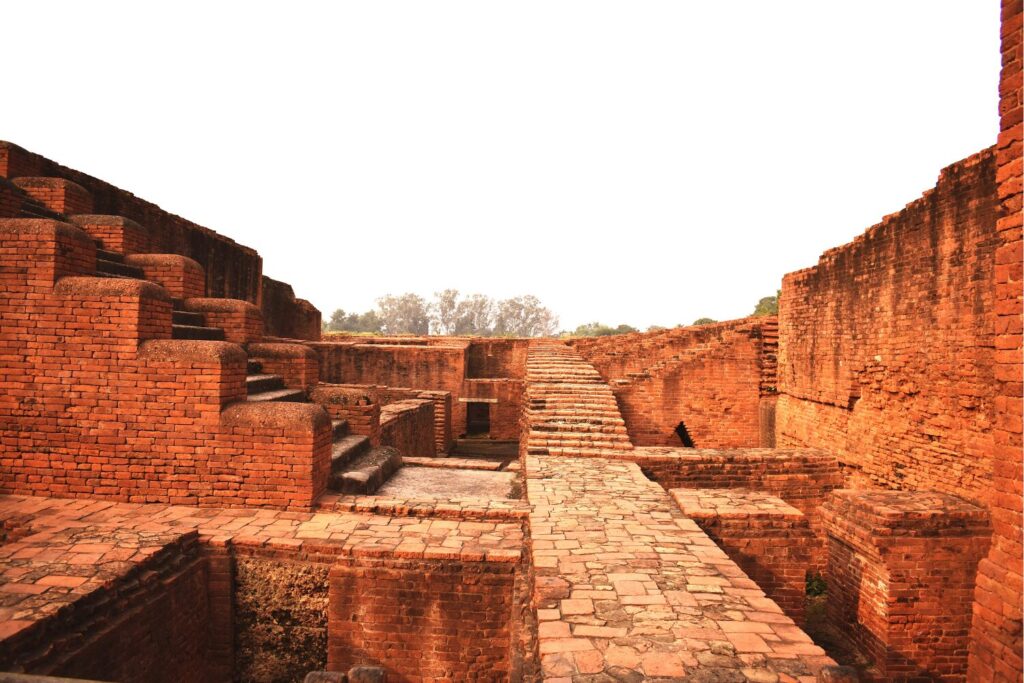
The most unique feature of Nalanda’s archeological heritage is its Architecture and Town Planning. Excavations have proved that Nalanda was not just a university, but a well-organized academic Township. Here, unique Architectural craftsmanship was used for study, residence, and meditation. Both the Gupta period Architectural style and the Pala period influence are evident in the construction of Nalanda. Red bricks were widely used here. The foundation and walls of the buildings were thick and strong, indicating that they were built with long -term use in mind. The viharas (Monasteries) and stupas adopted a mandapa style plan, where rooms were built around a central courtyard. This arrangement was suitable for education and meditation. Nalanda extended over an area of more than 12 hectares. Excavations have yielded nine large viharas (Monastery complexes) and numerous stupas. All of these appear to have been constructed under a well-organized plan. Rows of viharas were built in a north-south direction, parallel to which stupa complexes were constructed. All viharas had a central courtyard, around which rooms were built. Each vihara had a main entrance and a prayer hall near it. This town planning indicates that Nalanda functioned not only as a religious site but also as a residential and educational center. Each vihara was rectangular, and rooms for students and teachers were built around it. The central courtyard remained open for collective activities. Bricks and plaster were used in the rooms. Remains of two are three storied building have been found in some viharas. The ornamentation at the entrances of the viharas reflects the excellence of the art of that time.
Many stupa remains have been founded in Nalanda, the most famous of which is the Sariputra Stupa. This is an excellent example of Buddhist architecture. It’s architecture consists of multi-tiered brick steps. A circumambulatory path (pradakṣiṇāpath) was built around the stupas. Small stupas and Shrines were also constructed around them, which may have been built by devotees to gain merit. Large numbers of cley and metal images have been found in the ruins of Nalanda, which can be seen in the Nalanda Museum and various Museum around the world. These images reflect the excellence of the art of that time.
Sculpture and Artistic Traditions
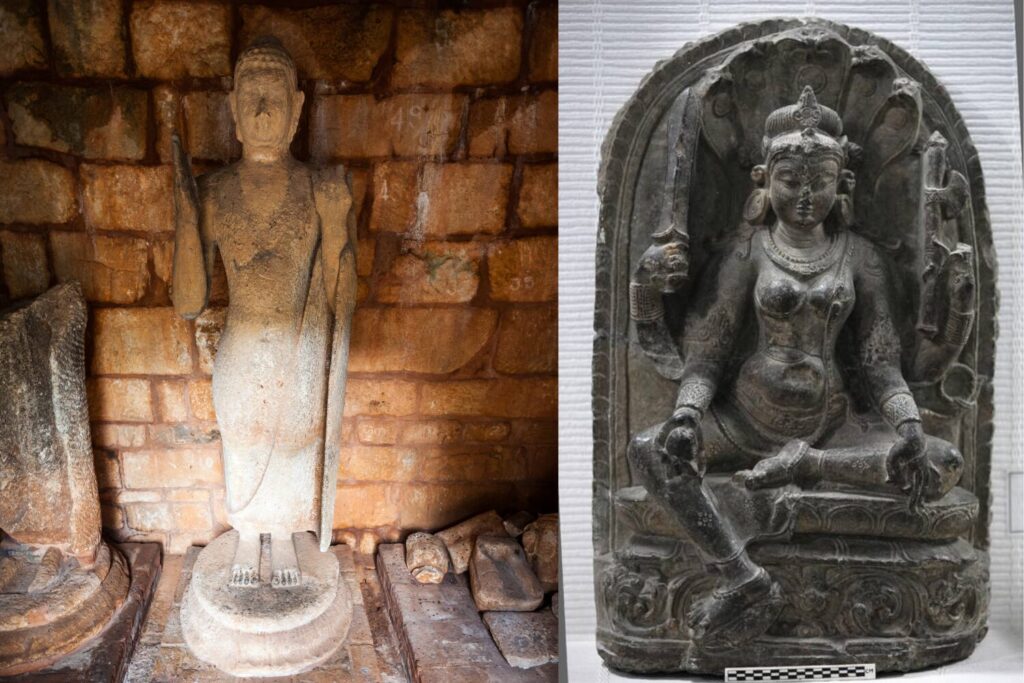
Sculpture holds a special place in the archeological heritage of Nalanda. The excavated statues and artistic remains here present an excellent example of the religious consciousness, cultural expression, and craftsmanship of that era. The sculpture of Nalanda has influenced not only the art tradition of India but also of entire Asia. The statues found in Nalanda show both the simplicity of the Gupta period and the grandeur of the Pala period. Most of the sculptures are made of red sandstone and black basalt stone. The physical forms in the statues are balanced, the expressions are calm and full of emotion. In Buddhist sculptures, Dhyana Mudra (meditation posture), Dharmachakra pravartana Mudra (turning the wheel of dharma), and Abhaya Mudra (fearlessness gesture) are especially common. The use of ornamentation on the statues is limited but artistic.
Nalanda is identified by it’s Buddha statues. Here, Buddha is depicted in various Mudras : Dhyana Mudra: calm, serene, and spiritual; Dharmachakra Pravartana Mudra: glimpse of Buddhist teachings; Abhaya Mudra: symbol of compassion and protection. From these sculptures, it is clear that Nalanda was not merely a place of study, but also a center for meditation and spiritual practice. Along with Buddha Statues, several Bodhisattva statues have also been found in Nalanda. The statues of Avalokiteshvara symbolize compassion and empathy. The statues of Manjushri were established as deities of knowledge and wisdom. In these statues, the use of jewelry, crowns, and ornamentation is found, which is a characteristics feature of Pala art. Among the excavated statues in Nalanda, female statues of Tara Devi and Prajnaparamita are particularly noteworthy. These statues present a wonderful blend of maternal affection and beauty. Evidence of ornamentation and carvings has also been found on the walls of viharas and stupas. Floral designs, geometric patterns, and small statues of deities were used as decorations. Figures made on bricks and terracotta plaques reflect that multifaceted nature of the art of that time. The sculpture of Nalanda has influenced not only India but also Nepal, Tibet, Myanmar, and China. The Nalanda style is clearly visible in Tibetan sculpture and vajrayana Buddhist art.
Educational and cultural contribute of Nalanda university
The greatest identity of Nalanda Mahavihara is its educational and cultural contribution. It was the world’s first residential university, Which deeply influenced not only India but also the intellectual stream of entire Asia. Education at Nalanda was highly organized and of a high standard. Approximately 10,000 students and 1,500 teachers resided here. The admission process was difficult; only those students who passed rigorous examinations could gain admission. The duration of study lasted for years, and student had to engage in deep study and discussion. Nalanda’s curriculum was very broad. Deep study of Buddhist philosophy- Hinayana, Maharana, vajrayana traditions. Teaching of grammar and linguistics- Sanskrit, Prakrit and foreign language. Logic and Nyaya philosophy promoting the tradition of debate. Emphasis was given to medical science (Ayurveda)-treatment of diseases, medicine manufacturing, and surgery; mathematics and astronomy-arithmetic, geometry, and study of planets and stars; Art and Architecture-sculpture, Architecture, and painting.
Education at Nalanda was based on scholastic discussions and debates. Students did not just study texts, but reached the depths of knowledge through logical discussions with their gurus. This system resembles the tutorial system of modern universities. Nalanda was not just a center of education, but also a cultural confluence where students from various countries of India and Asia exchanged cultures through mutual dialogue. Monks from China, Korea, Tibet, Myanmar, and Sri Lanka connected their traditions with the intellectual stream of India here. Nalanda spread the values of India compassion, tolerance, and intellectual freedom globally. Nalanda’s library was very rich. It was called “Dharmaganja”. It had three huge buildings-Ratnasagar, Ratnaranjak, and Ratnodadhi. Millions of manuscripts related to religion, philosophy, medicine, mathematics, and astrology were preserved here. This library was considered the greatest knowledge hub of ancient Asia. Nalanda’s influence was not limited to India. Scholars like Xuanzang and Yijing from China received education here and spread it’s impact. The deep intellectual stream of Nalanda also influenced the Buddhist traditions in countries like Tibet and Nepal in the north and Southeast Asian countries in the south.
Process of Conservation and Excavation
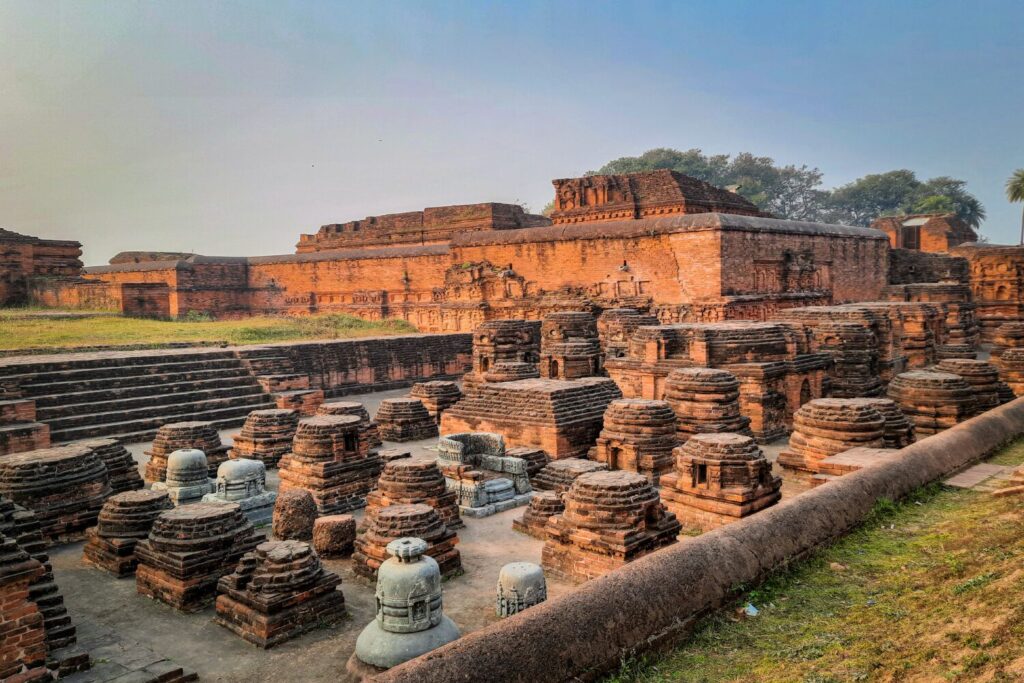
The archeological heritage of Nalanda, as it stands before us today, is the result of prolonged archaeological surveys, excavations, and Conservation efforts. This site remained abandoned for nearly 700 years, but its discovery and excavation during the colonial period re-established Nalanda’s historical and cultural identity. After Medieval invasions, Nalanda ley in ruins and remained neglected for centuries. In the 9th century, European scholars and archeologist discovered Nalanda based on travelogues (especially Xuanzang’s accounts). In 1861, Alexander Cunningham conducted An initial survey here and identified the ruins of Nalanda. From 1915 to 1937, officers like D.B. Spooner, J.A. Page and H.A.W. Johnson of the archeological survey of India (ASI) carried out extensive excavations. During this period, viharas, stupas, sculptures, and seals came to light. Most of the artifacts found during excavations are now preserved in the Nalanda Museum and Patna Museum.
After independence, the Archaeological survey of India took Nalanda under it’s protection. Broken structures were conserved and the site was developed for tourists. The Government of India declared Nalanda a protected monument of national importance. In the latter half of the 20th century and the 21st century, efforts were made to gain international recognition for Nalanda’s heritage. In 2016, UNESCO inscribed Nalanda Mahavihara as a world heritage site. This recognition has established Nalanda’s importance not only in India but also as a global cultural heritage. Despite Conservation efforts, some challenges persist: nature erosion (damage to bricks from rain, sun, and weather effects), increasing pressure from local population, tourist crowds and disorganized management, and lack of adequate financial and technical resources. Excavation and Conservation have revitalized Nalanda. These efforts have provided a glimpse into Nalanda’s original architectural from. Nalanda’s sculptures, inscriptions, and coins have come to light. This place is now developing as a cultural tourism center and an international research site.
Summary
Nalanda’s origin was a result of Gupta-period patronage and Pala period Conservation efforts. This site became the world’s largest and most organized Monastic university in the 5th century. This organization, education system, and curriculum inspired the establishment of other major universities in Asia, The remains of Nalanda’s viharas, stupas, and sculptures reflect the grandeur of ancient Indian art and architecture. These ruins, despite being religious and Artistic, also provide insights into the architectural skill and engineering of that period. The evidence of Nalanda’s archeological heritage teaches us that civilization can not be sustained by mere physical resources. Instead, it’s intellectual tradition also lives on. This heritage is a testament to the complete and comprehensive relationship that India has had with the world. This is why Nalanda is considered a symbol of India’s cultural and intellectual heritage in the world.
Bibliography
•Cunningham, A. (1871). Archaeological Survey of India: Four Reports Made During the Years 1862–65. Vol. I. Calcutta: Government of India.
•Ghosh, A. (1959). Nālandā: Memoirs of the Archaeological Survey of India, No. 66. New Delhi: Archaeological Survey of India.
•Xuanzang, H. (1996). Buddhist Records of the Western World (S. Beal, Trans.). Delhi: Motilal Banarsidass. (Original work published 646 CE).
•Yijing. (2000). A Record of the Buddhist Religion as Practised in India and the Malay Archipelago (J. Takakusu, Trans.). Delhi: Munshiram Monaural. (Original work published 691 CE).
•Singh Anand (2013). “Destruction and Decline of Nalanda Mahavihara: Prejudices and Praxis.” Journal of the Royal Asiatic Society of Sri Lanka, ns.,58(1): 23-49
•Huntington, S. L. (2014). The Art of Ancient India: Buddhist, Hindu, Jain. New York: Weatherhill.
•Mishra, R. K. (2001). Nālandā: Rediscovered. New Delhi: Sahitya Akademi.
•Singh, A. (2016). Buddhist Monasteries of India. New Delhi: Research India Press.
•Sinha, A. K. (2019). “Reassessing Nalanda: Archaeology and Heritage Management.” Journal of Indian History and Culture, 25(2), 145–170.
•UNESCO. (2016). Archaeological Site of Nalanda Mahavihara (Nalanda University), Bihar. Retrieved from https://whc.unesco.org/en/list/1502
•Archaeological Survey of India. (2021). Nalanda: Excavation Reports and Conservation. New Delhi: ASI Publications.
•Ray, H. P. (2022). “Knowledge Networks and Nalanda: Revisiting the Buddhist Learning Traditions.” Indian Historical Review, 49(1), 35–60.
•Singh, Anand (2022).”Origin of Nalanda Mahavihara: structure as Evidence and seal as Symbol.” Ancient Asia, 10:1-11. DOI: https://doi.org/10.5334/aa.273

Vipul Tiwari hails from Pratapgarh district of Uttar Pradesh and is a student of Indian heritage and history. His education includes BA Honours, Master’s degree in Ancient Indian History and Archaeology; Diploma in Indian Palaeography and Diploma in Indian Research Methodology . He has published several research papers. He is writer of books ‘Ayodhya ke Mandir evam Unki Sanrachna’ and ‘Baudh Dharm se Sambaddh Aitihasik Sthal- Bharat ke Pariprekshya mein’. He is currently working on his upcoming book is ‘Brihattar Bharat mein Aitihasik Baudh Sthal’.