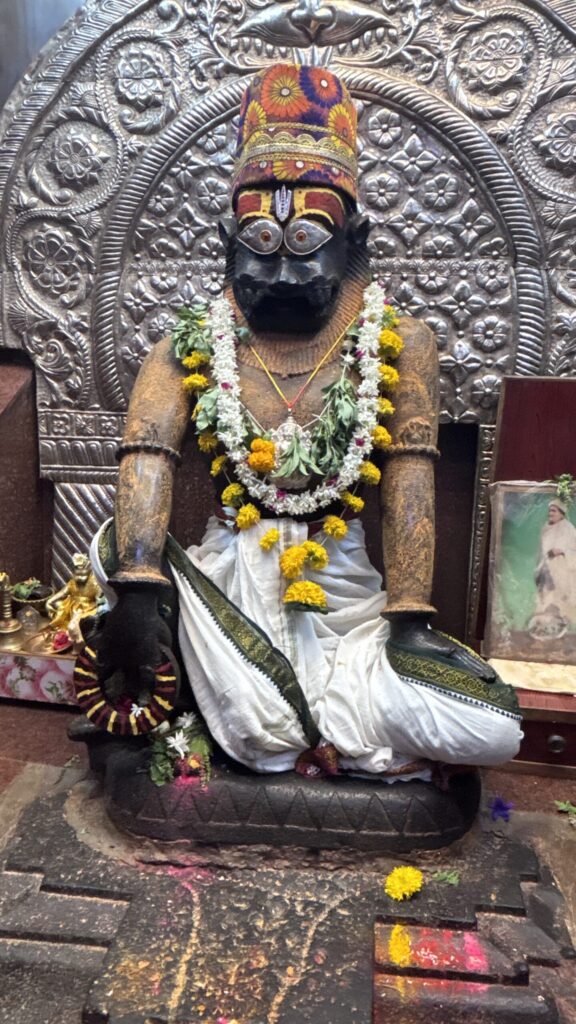
A rare and little-known idol of Kevala Narasimha, an uncommon iconographic form of Lord Narasimha, has come to light in Maharashtra’s Nanded city, drawing the attention of researchers studying medieval temple art and Vaishnava traditions of the Deccan.
The idol is presently preserved in the private shrine of the Deshmukh family in Nanded’s historic Sarafa-Holi locality. According to Pramod Deshmukh, the current head of the family, the deity has been worshipped continuously by at least ten generations of his family.
Deshmukh said family tradition traces the idol’s arrival to an ancestor who, nearly three centuries ago, dreamt of a Narasimha idol lying buried amid the debris of a ruined fort. Acting on the vision, the ancestor is said to have searched the site, recovered the sculpture, and installed it in the family’s home shrine, where it has remained ever since. “Our family has worshipped this deity for generations. We have always considered it our duty to preserve and serve the idol. Anyone who wishes to visit and seek blessings is welcome,” said Pramod Deshmukh.
Despite being present in the city for generations, the idol is virtually unknown outside the family and a small circle of devotees. Researchers believe that the sculpture represents a rare form known as Kevala Narasimha, in which the deity appears alone, without Lakshmi, Prahlada, or the demon Hiranyakashipu.
The image depicts Narasimha seated in a relaxed royal posture. Particularly noteworthy is the depiction of the Sudarshana Chakra positioned close to the ground, with the deity’s right hand resting upon it. The left hand rests naturally on the raised thigh, creating a composition that differs significantly from the more familiar fierce representations of Narasimha found across India.
Dr. Dinesh Soni of Indian.Temples Research & Media Services, who recently documented the sculpture, said the idol bears striking similarities to the celebrated Kevala Narasimha image at Ramtek in Nagpur district, one of the most important examples of this iconographic type.
“Examples of this form are extremely rare. The combination of a solitary Narasimha, a relaxed royal pose, and the chakra placed near the ground is unusual in Indian temple art. The Nanded image may represent an important but little-studied Deccan tradition of Narasimha iconography,” he said.
Preliminary comparisons indicate similarities with a small group of Narasimha sculptures reported from Maharashtra and Karnataka. Based on its iconographic features and sculptural style, the idol is tentatively believed to belong to the early medieval period, possibly between the 8th and 12th centuries CE. Experts caution, however, that further study is necessary before assigning a more precise date. Researchers believe the Nanded idol could help shed light on the spread of Vaishnava traditions across the Deccan and the evolution of Narasimha worship in the medieval period.