- Introduction
- Gita on the Go: Bringing Ancient Wisdom Into Everyday Life
- Bhagavad Gita for Everyday Living: A Practical Companion for the Modern Seeker
- What I learnt from both the Books
Introduction
We usually meet the Bhagavad Gita on a battlefield: Arjuna’s chariot stands between two armies, conch shells are blowing, and a warrior collapses in doubt. At first glance, it looks like a text about war. But the more we sit with it, the more we realise: Kurukshetra is not only a physical battlefield – it is the landscape of our mind.
Everyday life today is its own Kurukshetra: deadlines, family duties, health concerns, social media noise, and the quiet ache of “Am I really living my purpose?” The Gita steps into this chaos not as an abstract philosophy, but as a manual for conscious living.
Two recent books help bring this out very clearly for modern readers:
– “Gita on the Go: Quick Lessons from the Bhagavad Gita for Modern Life” by Aakriti Bansal
– “Bhagavad Gita for Everyday Living: Selected Verses with Key Takeaways” by Swami Mukundananda
Together, these two works show how the ancient dialogue between Krishna and Arjuna can still guide our mornings, meetings, and midlife crises. Here is my small review about both the books.
Gita on the Go: Bringing Ancient Wisdom Into Everyday Life
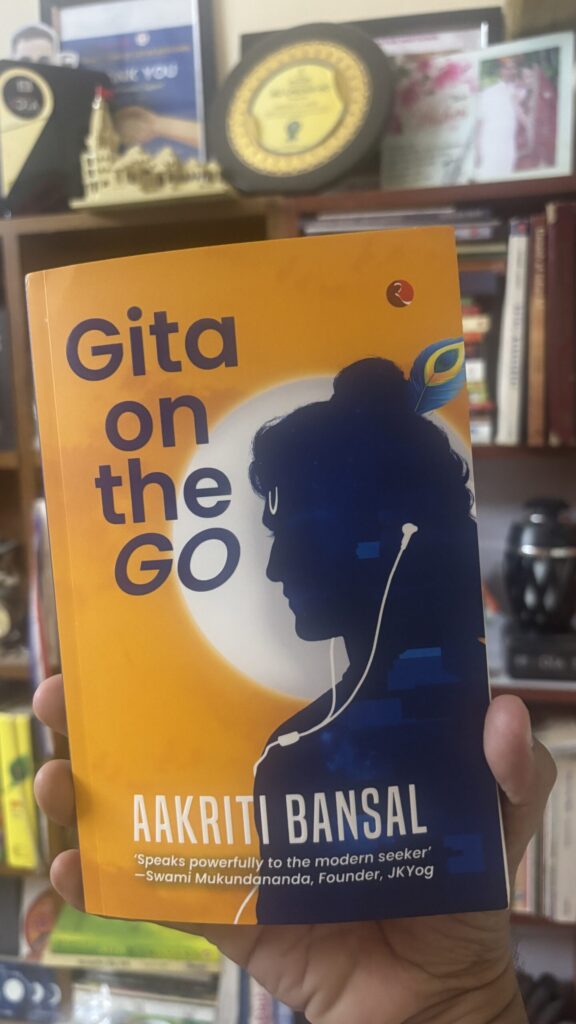
In an age where the pace of life grows faster than our ability to process it, spiritual texts like the Bhagavad Gita often feel distant — revered, yet unreachable. Many want to understand its timeless wisdom, but the idea of reading a 700-verse scripture or heavy commentaries feels overwhelming. It is into this gap that Aakriti Bansal steps in with her thoughtful, accessible, and emotionally resonant book, Gita on the Go | Quick Lessons from the Bhagavad Gita for Modern Life.
Rather than retelling the Gita in a traditional format, Bansal uses eleven contemporary stories, each centred around a relatable human struggle — self-doubt, grief, work pressure, guilt, heartbreak, trauma, and confusion. In each chapter, we meet ordinary individuals facing moments that feel like their own Kurukshetra, and it is here that the author gently brings in a teaching from Krishna.
A Modern Lens on Timeless Teachings
What makes the book refreshing is its simplicity. Bansal does not drown the reader in Sanskrit verses or commentary on Gita. Instead, her narrative style feels like a compassionate conversation. Each story distils a Gita principle into something emotionally understandable. The dilemmas are modern:
- A young professional dealing with panic attacks
- A woman struggling with identity
- A student battling fear and performance pressure
- A parent wrestling with guilt
- A person navigating loss and loneliness
In these raw moments, the Gita’s teachings enter not as philosophical lectures but as insights woven into everyday life. This makes the book an excellent entry point for readers intimidated by classical scriptures.
Where the Book Triumphs
One of the book’s biggest strengths is how deeply relatable it feels. Instead of presenting the Gita as something divine and distant, Bansal grounds it in the messy, emotional realities of modern living. The lessons are not about renunciation or abstraction — they are about breathing through confusion, anchoring oneself in clarity, and remembering that inner stability is possible even when life feels chaotic.
The writing is smooth, simple, and heartfelt. It never tries to impress; it tries to connect. And because of this, readers who might never pick up a religious text will find themselves drawn in.
A Gentle Companion, Not a Scholarly Commentary
Readers looking for a verse-by-verse study or theological analysis will not find it here — and that is intentional. Gita on the Go is not meant to replace the scripture. It serves as a bridge, helping readers understand how the Gita’s themes of duty, courage, surrender, mental clarity, and emotional resilience can help them navigate life’s uncertainties.
Its purpose is not depth but accessibility. It opens a door that many people hesitate to approach.
Why This Book Matters Today
We live in a world that is materially abundant and emotionally fragile. Anxiety, restlessness, burnout, and confusion define much of modern adulthood. In such a climate, books like Gita on the Go offer something invaluable — not a solution to all problems, but a pause, a perspective, and a reminder that timeless wisdom still speaks to us.
Aakriti Bansal succeeds in what she sets out to do: to make the Gita walk with us in metros, offices, living rooms, and lonely nights. To take Krishna’s message from the battlefield and place it gently into the hands of the modern seeker.
Final Thoughts
Gita on the Go is a warm, empathetic, and beautifully accessible guide for anyone seeking clarity without complexity. It is perfect for young readers, beginners in spiritual exploration, working professionals, or anyone feeling adrift in the noise of modern life.
Rather than being a book you read once, it is a book you return to whenever you need grounding — a quiet companion offering strength, comfort, and perspective.
If the classical Gita is the ocean, this book is a cup of its water — small enough to hold, yet powerful enough to refresh.
Bhagavad Gita for Everyday Living: A Practical Companion for the Modern Seeker

The Bhagavad Gita has been interpreted for centuries through countless commentaries, translations, and discourses. Yet each era requires its own voice — a guide who can distill the scripture’s timeless truths into insights that resonate with the challenges of that generation. In Bhagavad Gita for Everyday Living: Selected Verses with Key Takeaways, Swami Mukundananda offers exactly that: a clear, structured, and deeply practical companion for applying the Gita’s wisdom to daily life.
This book is not merely an explanation of verses; it is a manual for living with purpose, clarity, and inner stability.
A Structured, Practical Approach to the Gita
Unlike narrative-driven books that weave scripture into stories, Swami Mukundananda’s approach is direct, disciplined, and learning-oriented. He selects key verses from the Gita and presents them with lucid explanations, practical takeaways, psychological insights, spiritual reflections and action points for daily life. This makes the book especially valuable for readers who want straightforward guidance without wading through dense philosophical detail.
Where the Book Shines
1. Clear explanations without oversimplification
The Gita’s teachings are profound and layered. Swami Mukundananda retains their depth but explains them in a way that the modern reader — whether a student, professional, or homemaker — can easily absorb. His years of teaching, meditation practice, and scriptural study shine through in his clarity.
2. Action-oriented key takeaways
Every verse is accompanied by practical guidance, making this not just a book to read but a book to use.
The takeaways turn lofty ideas into:
- daily habits
- mindset shifts
- emotional tools
- approaches to decision-making
- spiritual practices
The emphasis on application is one of the book’s greatest strengths.
3. A holistic view of life
Swami Mukundananda bridges the Gita’s philosophy with:
- emotional well-being
- mental discipline
- work ethics
- self-development
- relationships
- leadership
- spirituality
This multi-dimensional approach makes the Gita feel like a walkable path, not an abstract scripture.
4. Suitable for both beginners and experienced seekers
For newcomers, the book acts as a gentle introduction to the Gita’s foundational wisdom.
For longstanding students, the selected verses and crisp insights offer a refresher — a way to revisit the essence of the Gita with renewed focus.
Not Just Spiritual Theory — A Lifestyle Guide
The core message that emerges through the book is this:
Spirituality is not separate from life; it is the way we live life.
Swami Mukundananda repeatedly emphasizes discipline, self-awareness, responsibility, and surrender — but always through a spiritual lens that is rooted in practicality. His explanations show how the Gita can guide:
- dealing with stress
- regulating emotions
- navigating ethical dilemmas
- understanding duty and purpose
- cultivating devotion over ego
- strengthening resilience
In this sense, Bhagavad Gita for Everyday Living becomes a handbook for inner transformation.
A Calm, Reassuring Voice
One of the book’s most comforting qualities is its tone — patient, compassionate, and rooted in wisdom. Swami Mukundananda’s writing feels like a conversation with a teacher who understands the struggles of the modern world and gently offers direction without judgment.
I found his voice soothing yet motivating, making the book an excellent companion during moments of confusion or emotional upheaval. This book is meant to be practical, not exhaustive. So, readers looking for a verse-by-verse commentary of all 700 shlokas or scholarly comparisons may find this selection too focused and concise.
But for readers who want clarity, practicality, and spiritual grounding, the book serves its purpose beautifully.
Final Thoughts
Bhagavad Gita for Everyday Living is a valuable guide for anyone seeking to bring spiritual wisdom into everyday choices. Its clarity, structure, and practicality make it an ideal companion for personal growth, emotional resilience, and inner reflection.
In a world filled with noise, distraction, and uncertainty, Swami Mukundananda offers a steady voice — reminding us that the Gita is not a scripture to be worshipped from a distance, but a living guide meant to illuminate every step of our daily journey.
Whether you’re new to the Gita or revisiting it, this book offers digestible wisdom, steady grounding, and a clear roadmap for living with purpose and peace.
What I learnt from both the Books
1. Clarity of Dharma in a Confusing World
One of the deepest pains of modern life is confusion. Arjuna’s breakdown in the first chapter is exactly this. The Gita clarifies dharma – the right action aligned with a higher purpose. In “Gita on the Go,” Bansal uses relatable stories of everyday dilemmas. In “Bhagavad Gita for Everyday Living,” Swami Mukundananda highlights clarity of purpose and intentional living.
2. Mastering the Mind: The Real Battlefield
Krishna teaches that the mind can be our best friend or worst enemy. Today, distractions and emotional turbulence dominate modern life. Both books emphasize mind-management, emotional resilience, and choosing conscious responses over reactions.
3. Acting Without Attachment
The famous teaching of 2.47 reminds us: we control effort, not outcomes. Swami Mukundananda explains this as freedom from anxiety about success. Bansal illustrates it with real-life scenarios like exams, appraisals, and parenting challenges.
4. Relationships and Letting Go of Ego
The Gita reframes relationships beyond ego and possession, encouraging role-based clarity and compassion. Both authors interpret these insights through modern interpersonal conflicts, helping readers shift perspective.
5. Building a Simple Gita Practice
Simple practices:
– One verse a day
– Story-based reflections
– Key takeaways for daily living
– Weekly “inner Kurukshetra” check-in
Conclusion: The Gita Lives in Our Choices
The Bhagavad Gita’s power lies in how it changes daily decisions. Both books make Krishna’s wisdom accessible, actionable, and deeply relevant for today’s world.
Its teachings do not ask us to renounce life, but to live it consciously, courageously, and compassionately.

Dinesh is an an indologist and is writer of 18 books. He holds a doctorate in cultural studies. He is felicitated by Acedemia Sinica, Taipei, Taiwan for his research in mythology. He has received numerous awards including the Lokmat Digital Influencer Award (Heritage). Dinesh is also a speaker who has graced many occasions. He is the main admin of Indian.Temples.