
Every single year, the arrival of the summer vacation meant one thing: going back home to the coastal soil of Tulu Nadu. For those of us who grew up passing through the green, rain-washed landscape stretched between the Arabian Sea and the Western Ghats, summer wasn’t just a break from a routine. It was a complete sensory plunge into a different world. It was the rich smell of ripe jackfruit, the heavy, humid air of the village, and the electric anticipation of the night when the entire countryside would come alive for the annual Bhoota Kola.
To an outsider, this ritual might seem like a distant spectacle of intense performance, heavy makeup, and striking trance. But when you grow up seeing it every summer vacation, it becomes a core layer of who you are. The heavy, rhythmic beating of the drums and the piercing blast of the horn cutting through the midnight silence aren’t just external sounds; they are visceral vibrations that match your own heartbeat. It is a living, breathing institution that teaches you, from the time you are a child, exactly what it means to belong to a community, a lineage, and a sacred geography.
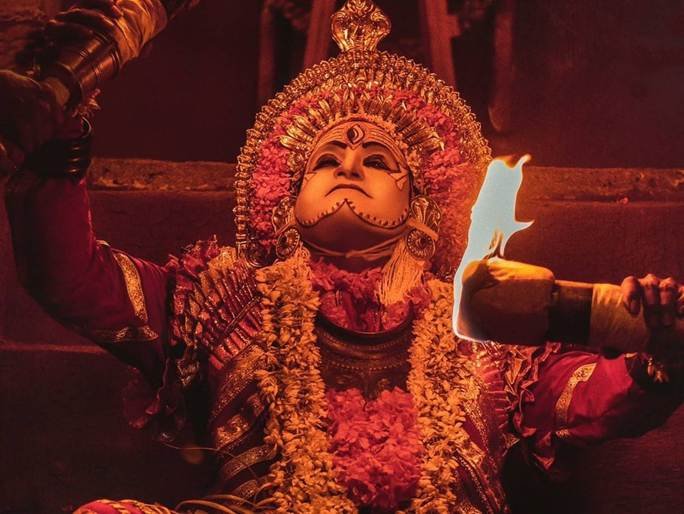
IMAGE SOURCE: KANTARA MOVIE, 2022
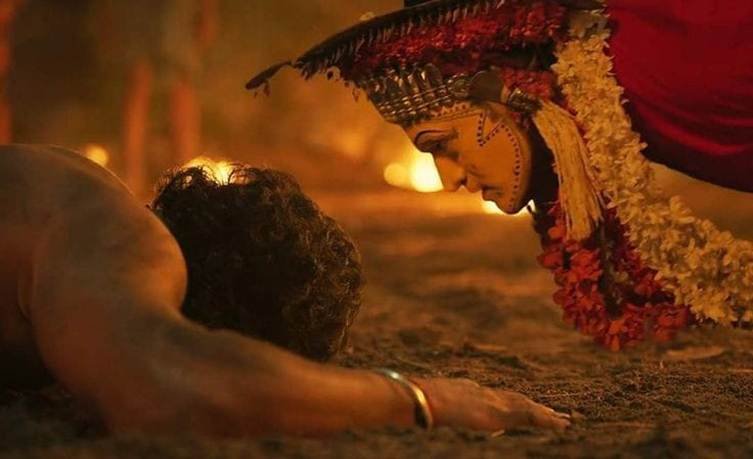
IMAGE SOURCE: KANTARA MOVIE, 2022
The Historical Landscape: The Roots of Tuluva Identity
Tuluva identity has always held onto its unique path with a fierce, quiet pride. While mainstream regional cultures often point toward grand, centralized temple networks, our home has preserved an intensely intimate, localized spiritual ecosystem. Power and protection here aren’t held by distant, abstract authorities; they belong to the Daivas (spirits) the ancient guardians of our specific fields, forests, and boundaries.
This history isn’t trapped in dry textbooks or rigid stone inscriptions alone. It lives and breathes in the Paddanas, the beautiful, haunting oral epics sung during the Kola nights. Growing up, listening to these long narratives makes you realize they are the true, unadulterated archives of our people. Passed down through generations, they tell the raw stories of deified heroes, warriors, and forces of nature who fought for dignity, stood up against social oppression, and sacrificed everything to protect the clan.
The spirits we eagerly look for every summer have real names, distinct personalities, and deep historical resonance: (These are just four of them; there are many other spirits guarding this bhoomi.)
- Panjurli: The ancient, roaring wild boar spirit who fiercely guards the boundaries of our agricultural lands and crops. This is the exact, primal energy that the world recently witnessed with awe in the cinematic masterpiece Kantara.
- Koti and Chennaya: The legendary twin heroes whose saga of brotherhood, honor, and unmatched valor still brings tears to the eyes of anyone who understands the Tulu language.
- Koragajja: The beloved, deeply protective guardian spirit of the everyday people, turned to as an approachable elder and the ultimate problem-solver for lost things and sudden crises.
- Kalkuda and Kallurti: The tragic artisan siblings who manifested as spirits, standing as eternal protectors of truth and absolute justice.
When the Night Catches Fire: The Experience of the Kola
There is a specific magic to a summer Kola night that you can never fully replicate or forget. The village Sthana (shrine) is meticulously cleared, surrounded by tall coconut palms and areca nut trees rustling in the warm night breeze. A quiet tension builds all day as the medium belonging to traditional, dedicated lineages like the Pambada, Parava, or Nalike fasts and prepares his mind and body for the descent of the divine.
As the oil torches are lit, casting long, dancing shadows against the dark forest canopy, the performance begins. The medium dons heavy, bright face paint, a structure of intricate traditional ornaments, and a massive, towering skirt made of fresh palm leaves.
When the music hits its highest, most frantic peak, the atmosphere completely shifts. The medium enters the deep, shivering trance of the Avesha. In that exact moment, the human actor completely recedes, and the Daiva arrives. Anyone who has watched this under the open sky knows the visceral, spine-chilling feeling of that transition the same raw, breathless moment captured so powerfully in Kantara, where the boundary between our material world and the supernatural completely vanishes.
But what makes this truly unforgettable is what happens next. The Daiva doesn’t remain a distant figure on a stage; the spirit walks right into the crowd to interact directly with the families:
- The Ultimate Arbiter: The Daiva listens to the real, messy, day-to-day problems of the village. Neighbours fighting over a shared land boundary, family feuds that have dragged on for years, or individual heartbreaks everything is brought before the spirit. The Daiva’s word is absolute. It is a beautifully direct, community-led system of restorative justice that has kept our villages whole for generations without the need for courts or police.
- The Voice of Assurance: The spirit looks into the eyes of the villagers, calling out the elders by their traditional family names, offering personal blessings, and promising that the lineage will be protected. When the Daiva holds out a hand of reassurance, giving Abhaya to a worried grandmother or a struggling farmer, the relief in the crowd is tangible.
- A Space Where All Are Equal: In a society often fractured by rigid structural lines, the Kola is a radical, equalizing space. The spirit addresses the wealthiest landlord and the humblest labourer with the exact same absolute authority, frequently reprimanding the powerful if they have treated others unfairly.
A Public Systems Perspective: The Ecological and Social Common
Looking at this tradition today through an analytical lens, it becomes incredibly clear that our ancestors designed a brilliant system of social and environmental governance disguised as sacred reverence.
1. Guardians of the Green
The worship of our Daivas is completely inseparable from the protection of the Nagabanis (sacred serpent groves) and the thick mini-forests that border our shrines. These are pristine enclaves of nature where not a single branch can be broken or a single stone moved, out of deep respect for the spirits. In our fragile coastal ecosystem, these groves serve as vital biodiversity hubs that protect native plants, preserve local water tables, and prevent soil erosion. Long before modern environmental policies existed, our home successfully enforced conservation through the sacred fear and love of the Bhootas. It is the exact theme Kantara highlighted: the inevitable friction that happens when centralized state laws try to override the organic, deeply emotional ecological guardianship of the people who belong to the land.
2. The Anchor That Pulls Us Back
More than anything, the annual Kola is an emotional anchor. No matter how far we migrate for education, advanced research, or career opportunities, and no matter how globalized our lives become, the summer vacation calls us back to the exact same soil. It is an institutional mechanism for social cohesion. Standing shoulder-to-shoulder with your relatives in the glowing torchlight, you reconnect with your roots, kinship networks are restored, and the collective memory of who we are is passed down effortlessly to the next generation.
Conclusion: The Unbroken Circle
The true uniqueness of Tulu Nadu lies in this stubborn, beautiful refusal to let go of its roots. While the modern world pushes for uniformity, our coast continues to revere the spirits of the soil, the protectors of the fields, and the ancestors who walked these paths before us.
The Bhoota Kola is not a relic of a bygone era or a performative piece of folklore; it is a living, breathing archive of our history and our moral compass. For those of us who grew up with these summer memories, the rhythmic, heavy beats, the smell of burning oil torches, and the resonant, shivering voice of the Daiva speaking truth in the dead of night are eternal reminders of exactly where we come from. It is a sacred system where landscape, identity, and the common good remain beautifully, defiantly whole.

S S Sneha is a postgraduate public policy scholar and historian who views India’s ancient heritage through the lens of modern governance. Specializing in public systems, she explores how Hinduism, mythology, and sacred spaces historically functioned as decentralized institutions for social administration and resource management. By unearthing the timeless narratives of regional traditions, she bridges the gap between ancient cultural legacies and contemporary policy insights. Learning from yesterday, designing for tomorrow.