To understand Krishna as the Dharma Sthapaka (re-establisher of righteous order) and the master political strategist of the Mahabharata, one must look at his early life. The experiences of his youth in Gokula and Vrindavan were not merely incidental episodes of idyllic boyhood; they were the foundational training ground that shaped his worldview, tactical genius, and deep empathy for humanity.
Long before he advised kings or directed the course of the Kurukshetra war, Krishna lived the realities of the common folk. That grounded upbringing became the bedrock of his vision for Dharma.
1. Pastoral Living: Empathy for the Margins
Krishna grew up among the Gopas (cowherds) a working-class, pastoral community dependent on cattle, pastures, and seasonal cycles. He did not spend his formative years in royal courts, isolated by palace walls or formal statecraft.
- The Lesson: He experienced the vulnerabilities, labor, and economic realities of everyday people firsthand.
- The Evolution: Because he understood the struggles of the common individual, his concept of Dharma was never abstract or purely theoretical. When he later acted as a kingmaker, his decisions prioritized structural stability and popular welfare over the self-serving ambitions of dynastic rulers.
2. Breaking Rigid Authority: The Govardhana Leela
When the people of Vrindavan prepared for their traditional, high-stakes sacrifice to Indra, the king of the gods, Krishna challenged the status quo. He argued that their primary duty and gratitude should go to the immediate ecosystem that sustained them the Govardhana hill, the forests, and the cattle rather than distant, intimidating authority figures.
- The Lesson: Authority must be earned through protection and utility, not demanded through fear or blind ritualism.
- The Evolution: This episode revealed early traits of an institutional reformer. Krishna taught the community to question entrenched hierarchies and value local, practical sustenance over rigid orthodoxy a core principle he later applied when challenging tyrannical rulers like Kamsa and Jarasandha.
3. Playfulness and Conflict Resolution: The Cowherd Leader
Leading the boys of Vrindavan through forests, managing herds, and navigating everyday hazards required informal leadership. Whether mediating disputes among playmates, dealing with wild threats in the forest, or organizing collective games, Krishna led through affection, shared trust, and charisma rather than coercion.
- The Lesson: Leadership thrives on relational trust, adaptability, and psychological insight into human nature.
- The Evolution: This deep understanding of human psychology became his greatest tool as a diplomat and strategist. He could read the distinct motivations, flaws, and strengths of leaders like Yudhishthira, Arjuna, Bhima, Duryodhana, and Karna, guiding complex political alliances with unmatched precision.
4. Facing Early Adversity: Calmness Amid Danger
From a very young age, Krishna faced continuous, existential threats sent by Kamsa. Rather than instilling fear, these early encounters cultivated absolute composure under pressure.
- The Lesson: Adversity is met not with panic, but with resourcefulness, presence of mind, and decisive action.
- The Evolution: This unshakeable inner stability directly translated into his role on the battlefield of Kurukshetra. As an unarmed charioteer guiding Arjuna through moral paralysis and chaotic warfare, Krishna remained the calm, unwavering anchor of Dharma.
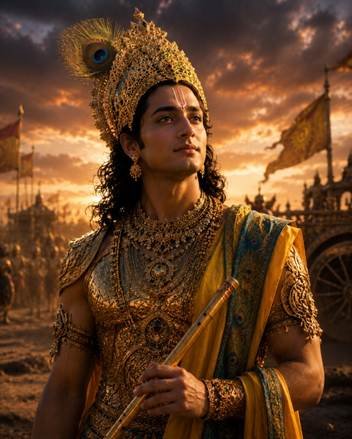
The Transformation: From Cowherd to Kingmaker
Krishna’s journey demonstrates that true leadership does not begin with a crown; it begins with an intimate understanding of life at the grassroots.
By the time he stepped onto the political stage of Mathura, Dwaraka, and Hastinapura, he possessed a rare combination: the tactical sharpness needed to dismantle corrupt regimes, and the profound empathy required to re-establish a just society. His childhood in Gokula did not just precede his role as a Dharma Sthapaka, it created it.

S S Sneha is a postgraduate public policy scholar and historian who views India’s ancient heritage through the lens of modern governance. Specializing in public systems, she explores how Hinduism, mythology, and sacred spaces historically functioned as decentralized institutions for social administration and resource management. By unearthing the timeless narratives of regional traditions, she bridges the gap between ancient cultural legacies and contemporary policy insights. Learning from yesterday, designing for tomorrow.