 The landscape of Tulu Nadu is dotted with temples that serve as far more than religious centers; they are repositories of local identity and environmental history. While grander regional structures draw global attention, the Alevoor Shri Durga Parameshwari Temple remains an intimate, potent sanctuary rooted in the region’s mystical heritage. Believed to be over 800 years old, this Alupa-era shrine stands as a testament to an enduring feminine power manifested in a form that challenges conventional iconography.
The Essence of a Gramadevi: Where the Cosmic Meets the Local
To truly understand a shrine like Alevoor, one must understand the unique concept of a Gramadevi (Village Goddess). In the broader landscape of Indian spirituality, a Gramadevi represents a profoundly intimate form of divinity one that differs fundamentally from the distant, grand deities found in text-based mythological epics.
When we look closely at how a Gramadevi functions within rural society, several distinct pillars emerge:
- The Ultimate Geographical Guardian: A Gramadevi is the literal protector of a specific village’s boundaries. Her cosmic duty is highly practical rather than abstractly spiritual; she is tasked with protecting the soil from famine, guarding livestock against disease, safeguarding local water bodies, and shielding the community from epidemics or external harm.
- An Intimate, Familial Bond: Unlike the formal atmosphere of major centralized pilgrimage sites, the relationship with a Gramadevi is conversational, deeply personal, and treated much like a bond with a village matriarch. Devotees visit her not just to perform rigid rituals, but to share daily life updates, seek blessings before marriage or travel, and offer direct gratitude for seasonal rains.
- The Heart of Historic Governance: As seen in the Seeme (territorial) traditions of Alevoor, the Gramadevi historically served as the supreme ethical anchor of the community. Oaths taken in her presence held absolute legal weight, and complex property disputes or collective resource issues—such as local water sharing—were mediated under her spiritual jurisdiction. She functioned as the invisible civic glue holding the socio-political fabric of the village together.
- Rooted in Nature and Antiquity: Gramadevi shrines almost always predate modern, rigid sectarian classifications like Vaishnavism or Shaivism. Their manifestation in nature-centric forms such as a stone Linga or an incarnation of Jala Durga (Water Durga) reveals an ancient origin where worship was inextricably tied to the protection of the immediate natural ecosystem.
The Mystery of the Linga-Roopa
In mainstream Shakta traditions, Durga is typically depicted in a multi-armed, anthropomorphic form vanquishing the demon Mahishasura. At Alevoor, however, the Goddess is worshipped as a Linga-Roopa.
This rare phenomenon where feminine energy (Shakti) is housed within a Linga traditionally associated with Shiva signifies an ancient synthesis of Shaivite and Shakta traditions unique to coastal Karnataka. Local lore identifies her as an incarnation of Jala Durga (Water Durga). While the foundational deity inside the sanctum is this rare stone form, she is beautifully adorned with a metallic mask (Mukhavada) for daily darshan, allowing devotees to connect with the familiar, compassionate face of the Mother Goddess. Historically, this setup points to origins that likely predate rigid sectarian divisions, highlighting an era of fluid, nature-centric worship.
The Legend of the Growing Stone
Beyond the sanctum lies a geographical mystery whispered through generations. Behind the Garbhagriha (sanctum sanctorum) sits a large, ancient stone known to locals as the “Elephant” the traditional vehicle (Vahana) of the Goddess.
Oral traditions maintain a fascinating observation: as decades pass, the “Elephant” stone is said to be slowly shrinking, while the Linga inside the sanctum gradually increases in size. Devotees view this not as a geological anomaly, but as a living sign of the Goddess’s deepening presence a powerful metaphor showing that as the external, physical world erodes, internal spiritual strength only grows.
Architectural Heritage as a Social Common
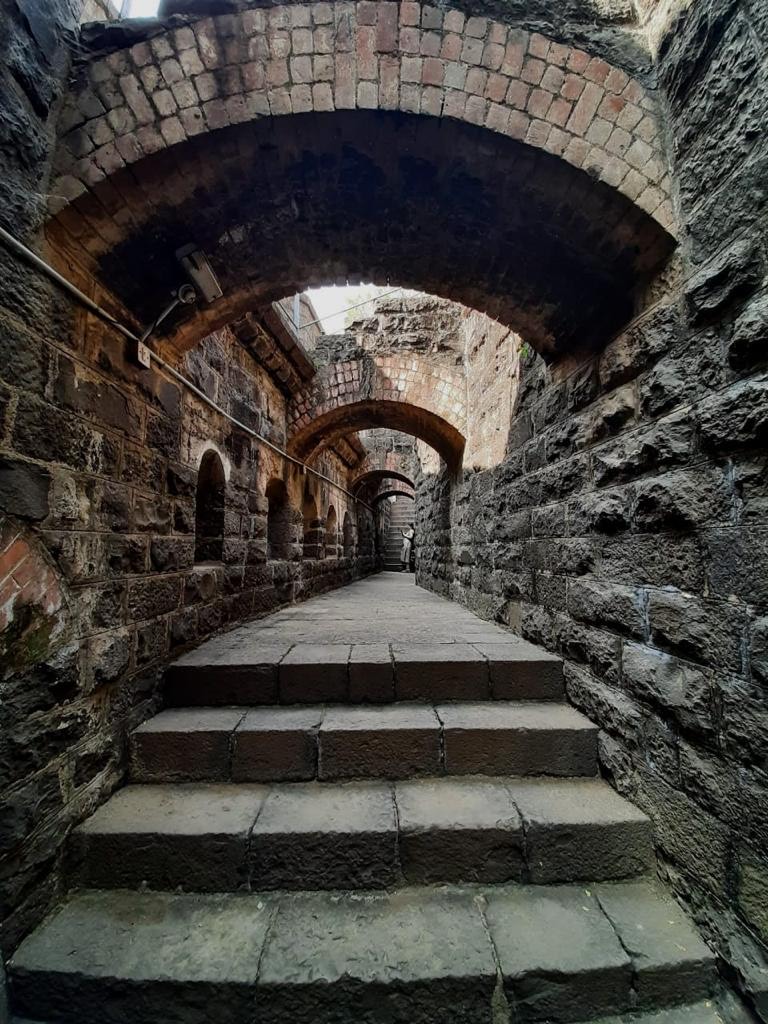
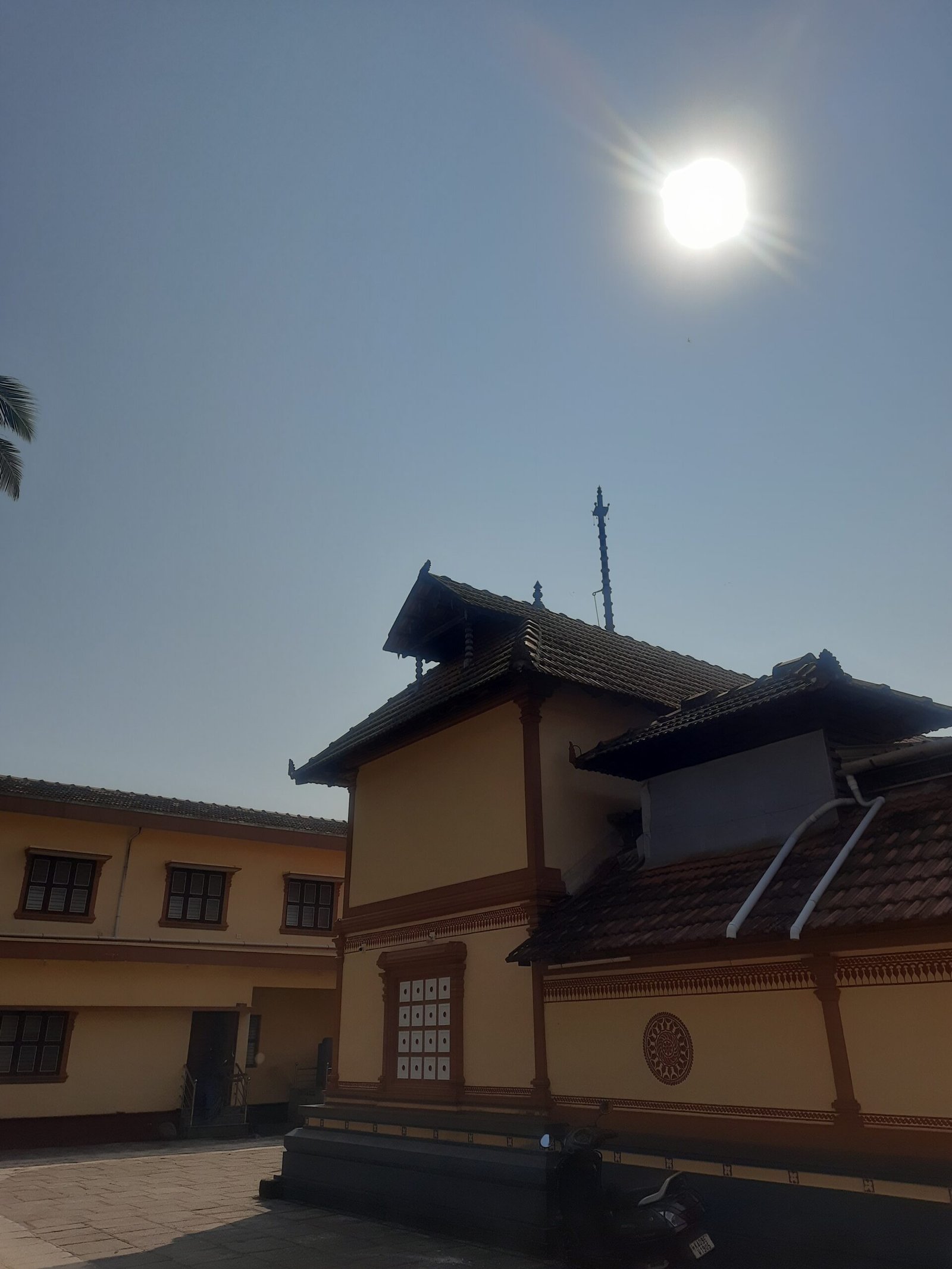
Architecturally, the temple reflects the classical Tulu Nadu style, featuring slanting roofs and heavy stone construction built to withstand torrential coastal monsoons. Its layout, characterized by a rare, rounded Garbhagriha and an elevated Pani Peeta, follows intricate Vastu Shilpa principles.
One cannot separate the temple from its unique topography. Directly behind the structure sits a serene stone hill that functions beautifully as a “social common”. In the evenings, it becomes a recreational space for the village community to gather and unwind. It is a prime example of how rural religious architecture naturally integrates with the landscape to provide public value, seamlessly bridging sacred space with everyday civic life.
Rituals and Territorial Governance
The temple adheres to Agamic and Pancharatra traditions, with its annual festival serving as the pinnacle of the local cultural calendar. During these celebrations, rituals involving the Pushpa Ratha (flower chariot) and various offerings are performed to ensure the fertility and well-being of the surrounding agricultural lands.
For a researcher, these rituals offer a clear window into the historic Seeme (territorial) governance of ancient South Karnataka. Historically, temples like Alevoor were true administrative hubs. They functioned as centers of the Seeme where local disputes were mediated and communal resources such as land and vital water systems were managed equitably under the watchful “eyes” of the deity.
Conclusion: A Living Archive
In an increasingly digitized and centralized world, the Alevoor Durga Parameshwari Temple endures as a living archive. It reminds us that history is not confined to dusty manuscripts; it lives in growing stones, unique architectural silhouettes, and the collective memory of a village. A climb up the adjacent stone hill at sunset, looking down at an 800-year-old sacred hearth, offers a profound perspective on time and community continuity that no textbook can replicate.

S S Sneha is a postgraduate public policy scholar and historian who views India’s ancient heritage through the lens of modern governance. Specializing in public systems, she explores how Hinduism, mythology, and sacred spaces historically functioned as decentralized institutions for social administration and resource management. By unearthing the timeless narratives of regional traditions, she bridges the gap between ancient cultural legacies and contemporary policy insights. Learning from yesterday, designing for tomorrow.