In the cultural landscape of India, spiritual identity is rarely a singular, homogenized experience. Instead, it is beautifully decentralized, structured through concentric circles of belonging. If the territorial guardian represents the protective matrix of a specific geographical boundary, the Kuladevaru (the ancestral lineage deity) represents the unbroken thread of familial continuity, genetic lineage, and spiritual inheritance. While families may migrate across various geographies over generations, the Kuladevaru remains entirely fixed an eternal anchor linking the individual back to their ancestors and their deep regional roots.
Nowhere is this concept more vividly realized than in the coastal belt of Karnataka, a region where sacred geography, ecological reverence, and ancestral lineages converge. For generations of families, this spiritual center is embodied in the ancient, serene sanctuary of the Ullooru Shri Karthikeya Subrahmanya Temple. Located along the Basrur-Hunsemakki Road in the tranquil village of Kandavara, within the Kundapura Taluk of the Udupi district, this sacred space reveals that a Kuladevaru is far more than a personal preference; it is a sophisticated sociological and institutional framework that has preserved community cohesion and ecological equilibrium for centuries.
The Architecture of Identity: Understanding the Kuladevaru
To understand the profound emotional and spiritual pull of a Kuladevaru, one must examine its role in the traditional Indian social fabric. The word Kula denotes a clan, lineage, or an extended family network sharing a common ancestry. Unlike major public deities worshipped primarily by changing masses at massive, centralized pilgrimage destinations, the Kuladevaru maintains a specific, deeply personal relationship with the clan.
Historically, the Kuladevaru is considered the prime spiritual witness to a family’s lineage history. It is the deity that saw the struggles of early ancestors, blessed the births of generations, and sustained the family through structural migrations, economic shifts, and historical upheavals. Within the framework of rural sociology, the yearly pilgrimage back to the Kuladevaru temple functions as a vital institutional mechanism:
- Socio-Centric Regrouping: It compels dispersed family members, who may have migrated to distant urban centers, to return to their ancestral soil, ensuring that kinship networks remain active, recognized, and resilient.
- Ethical Accountability: The Kuladevaru serves as the ultimate moral ledger of the clan. Major life events marriages, the launching of new enterprises, or severe family disputes are traditionally brought before this deity for validation, mediation, and blessings.
Ullooru Shri Karthikeya: The Confluence of Skanda and Naga Traditions
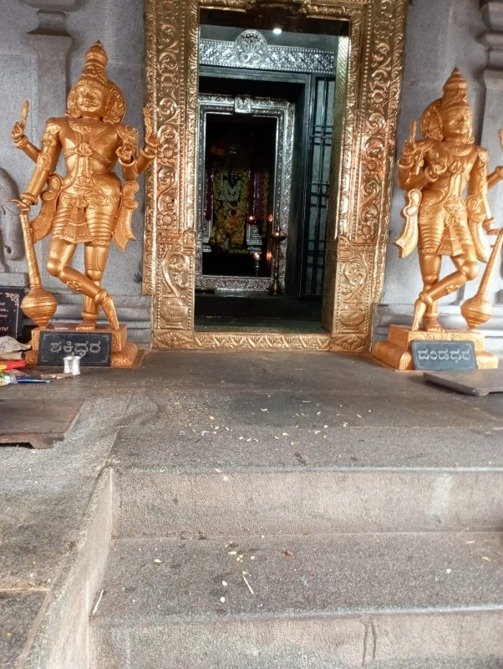
The Ullooru Shri Karthikeya Subrahmanya Temple stands as a magnificent manifestation of a Kuladevaru hub. Situated near the historic medieval trading region, the temple is dedicated to Lord Subrahmanya, manifested here as Karthikeya or Swamy Subrahmanya the son of Shiva and Parvati, and the divine commander of celestial forces.
In the unique cultural matrix of coastal Karnataka, the worship of Subrahmanya undergoes a fascinating theological synthesis. Here, Lord Subrahmanya is inextricably linked with Naga Aradhane (serpent worship). According to regional traditions, Skanda manifested in this coastal belt to protect the land, absorbing the ancient, indigenous earth-and-serpent traditions of the region.
At the Ullooru temple, this synthesis becomes a tangible, daily spiritual experience. The primary deity, Lord Karthikeya, is approached not just as a distant god of cosmic battles, but as a benevolent, accessible protector of the family line. Devotees seek the grace of the deity to resolve ancestral or elemental imbalances and to ensure the protection of their lineage. The deity, in essence, stands guard over the biological and spiritual preservation of the Kula.
Architectural Typography as a Reflection of Heritage
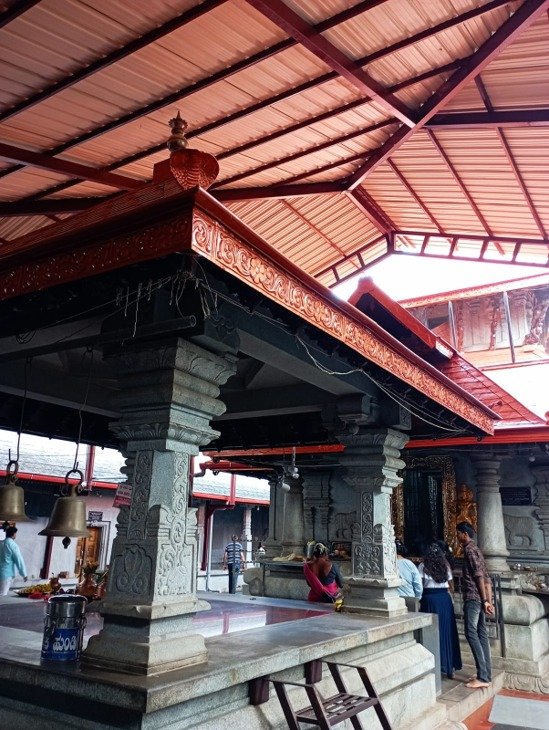
Architecturally, the Ullooru Shri Karthikeya Temple is a pristine example of the classic coastal Karnataka style, designed to harmonize with the tropical climate and heavy monsoon downpours of the region. Characterized by its low-slung, slanting roofs, distinct structural profiles, and robust construction, the temple layout emphasizes a clean transition from the external, material world to the profound silence of the inner sanctum.
The temple features a prominent Dhvaja Stambha (sacred flagstaff) outside, aligning the cosmic axis of the temple space. The outer courtyard allows devotees to perform Pradakshina (circumambulation) while looking outward at the rural landscape of Kandavara. The spatial design reflects a brilliant understanding of traditional architecture where the temple does not dominate the environment, but rather emerges naturally from it. For a family visiting their Kuladevaru, this specific layout evokes an immediate sense of “coming home” a physical return to the textures, sounds, and architectural silhouettes that defined their ancestors’ sensory world.
A Public Systems Perspective: The Kuladevaru as an Ecological and Institutional Common
For a researcher looking through a public systems lens, a Kuladevaru center like the Ullooru temple offers insights that go far beyond conventional religious studies. Historically, temples dedicated to Subrahmanya and Naga deities functioned as highly effective frameworks for community-led environmental and social governance:
- The Creation of Sacred Ecological Enclaves
Subrahmanya worship is fundamentally tied to the preservation of Nagabanis (sacred serpent groves). These are undisturbed patches of natural forest left entirely untouched by human interference, dedicated directly to the deity. From a modern environmental policy perspective, these groves serve as vital biodiversity hotspots, protecting indigenous flora, preserving local water tables, and preventing soil erosion in the fragile coastal ecosystem. By tying the preservation of these ecosystems to the reverence of the family’s Kuladevaru, ancient societies created a highly effective self-enforcing mechanism for conservation.
- Decentralized Social Security nets
Historically, the lineage temple acted as a decentralized hub for social welfare within the Kula. Families who achieved economic success would funnel resources back into the temple’s common systems. During times of agrarian crisis, famine, or individual family distress, the temple network could deploy these resources to support struggling members of the clan through educational support, community kitchens, or direct assistance. This formed an autonomous, community-funded social security net that minimized dependency on centralized external systems.
Conclusion: The Unbroken Circle of the Shrine
In a modern, highly globalized world characterized by rapid urbanization and individual fragmentation, the concept of the Kuladevaru has become more critical than ever. It acts as a powerful psychological and cultural antidote to the rootlessness of contemporary life.
The Ullooru Shri Karthikeya Subrahmanya Temple remains a living, breathing institutional archive. Listening to the resonant chants amidst the quiet rustle of the coastal palms, time compresses. Modern individuals stand exactly where their ancestors stood centuries ago, praying for the exact same foundational values: the health of the family, the fertility of the land, and the continuity of the lineage. Ultimately, Ullooru reminds us that while public systems and regimes evolve over time, it is these deep, ancestral anchors of faith, community commons, and ecological reverence that keep our cultural landscape enduringly whole.

S S Sneha is a postgraduate public policy scholar and historian who views India’s ancient heritage through the lens of modern governance. Specializing in public systems, she explores how Hinduism, mythology, and sacred spaces historically functioned as decentralized institutions for social administration and resource management. By unearthing the timeless narratives of regional traditions, she bridges the gap between ancient cultural legacies and contemporary policy insights. Learning from yesterday, designing for tomorrow.