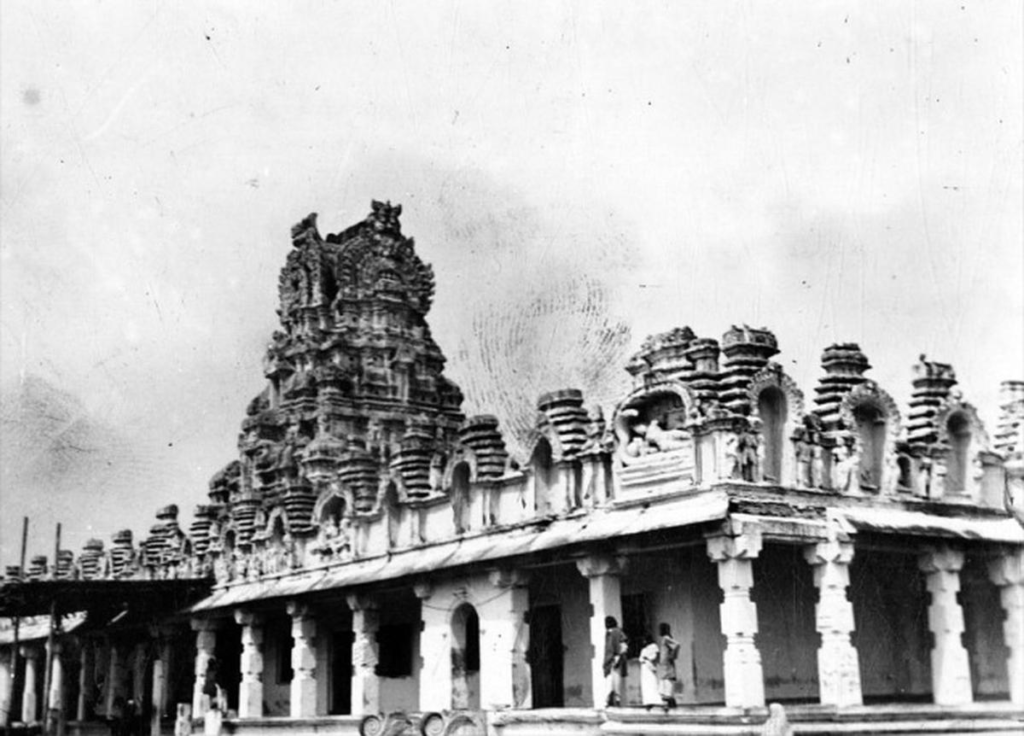
The coastal town of Udupi is often defined by the golden-plated window through which devotees catch a glimpse of Lord Krishna. Yet, for the thousands who visit daily, the divine experience is incomplete without a visit to the Bhojanashala. Here, the philosophy of Anna Daana (the gift of food) transcends simple charity, transforming into a rigorous spiritual discipline governed by the power of Mukhyaprana (Lord Hanuman).
The Theology of Anna Brahma
In the Dwaita philosophy established by Sri Madhvacharya, Krishna is revered as Anna Brahma—the Brahman manifested as food. Central to this belief is the presence of Mukhyaprana (Lord Hanuman). At the Udupi Sri Krishna Matha, Mukhyaprana is the celestial supervisor of the kitchen. Devotees believe that the food prepared here is first offered to Krishna and then distributed by his grace, ensuring that the hearth never goes cold and no seeker leaves hungry.
The Miracle That Built the Hearth: A Mother’s Faith
The history of the Bhojanashala is tied to a profound personal miracle documented in the Guru Charitra of the Shiroor Matha. Long before the grand dining hall existed, a young boy suffered from a debilitating illness that left him motionless and silent for a year. His mother, having exhausted all medicines, turned to the grace of Udupi’s Mukhyaprana.
Following a divine dream of a monkey receiving sacred offerings, she began a 48-day vow. Every day, she waited at the kitchen doors to collect the Prasada to feed her son. For 47 days, there was no change. On the 48th day, she returned home to an impossible sound: her son’s laughter. Inside, she found a large monkey cradling and playing with the boy. As she cried out in shock, the monkey snatched a bit of Prasada from her hand and vanished. Her son, bedridden for a year, stood up and ran to her.
That boy grew up to be Sri Lakshmisamudra Teertha, the 27th Swamiji of Shiroor Matha (ordained in 1887). To fulfill his mother’s secret vow of eternal Annadana, he chose the very ground where the temple cows once fed to build the bueatiful Bhojanashala. To complete the sanctity of the hall, he brought a massive stone idol of Hanuman from the ancient city gates of Jodukatte (Udupi) and installed it there, ensuring Mukhyaprana would forever watch over the devotees as they ate.
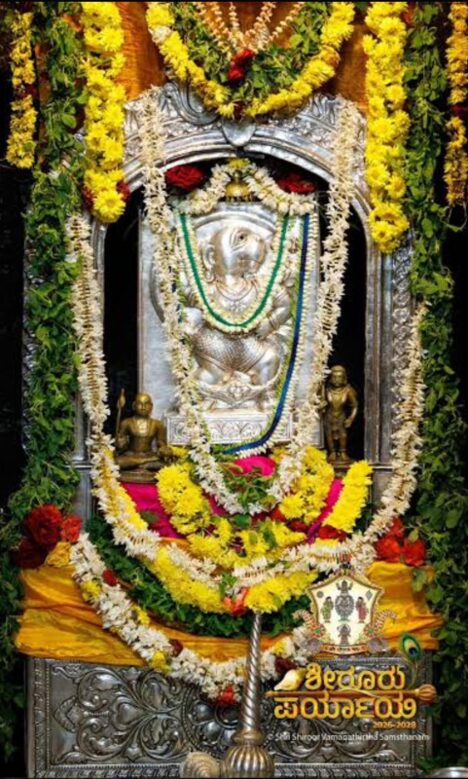
Source: Udupi Shiroor matha photo.
The Scale of Compassion and Governance
Today, the logistics of the Bhojanashala are a marvel. Every day, thousands of devotees sit in neat rows (Pankti) to partake in a strictly Sattvic meal. This operation is sustained by the Paryaya system, an 800-year-old democratic tradition where administration rotates among the eight monasteries (Ashta Mathas). Each presiding Swamiji views the feeding of bhaktas as their primary duty, maintaining a legacy of inclusivity that solves modern problems of food security through ancient faith.
A Culture of Equality
The most powerful aspect of Udupi’s food culture is its role as the “Great Equalizer.” Following the tradition set by Sri Lakshmisamudra Teertha, many devotees and even the Swamijis themselves choose to eat directly off the floor without a leaf, a practice believed to cure ailments and dissolve the ego. From scholars to pilgrims, everyone sits on the same level, sharing the same meal.
Writing about the Udupi Sri Krishna Matha is not just an exploration of a temple; it is a study of how a mother’s faith and a son’s gratitude built an institution that continues to nourish the body and soul of millions, centuries later.
References
- Shiroor Matha Official Website. Guru Parampara and Institutional History. Accessible at: https://shiroormatha.org/
- Acharya, P. Latavya. Udupi Bhojanashaleya Rochaka Itihasa ,Udupi.
- Hebbar, B. N. (2005). The Śrī-Kṛṣṇa Temple at Udupi: The History and Spiritual Center of the Madhva Sect.

S S Sneha is a postgraduate public policy scholar and historian who views India’s ancient heritage through the lens of modern governance. Specializing in public systems, she explores how Hinduism, mythology, and sacred spaces historically functioned as decentralized institutions for social administration and resource management. By unearthing the timeless narratives of regional traditions, she bridges the gap between ancient cultural legacies and contemporary policy insights. Learning from yesterday, designing for tomorrow.